Motivation Package:
“Fundamentals of Project Management”



Virtual kickoff meeting
1 hour, each one at his/her place
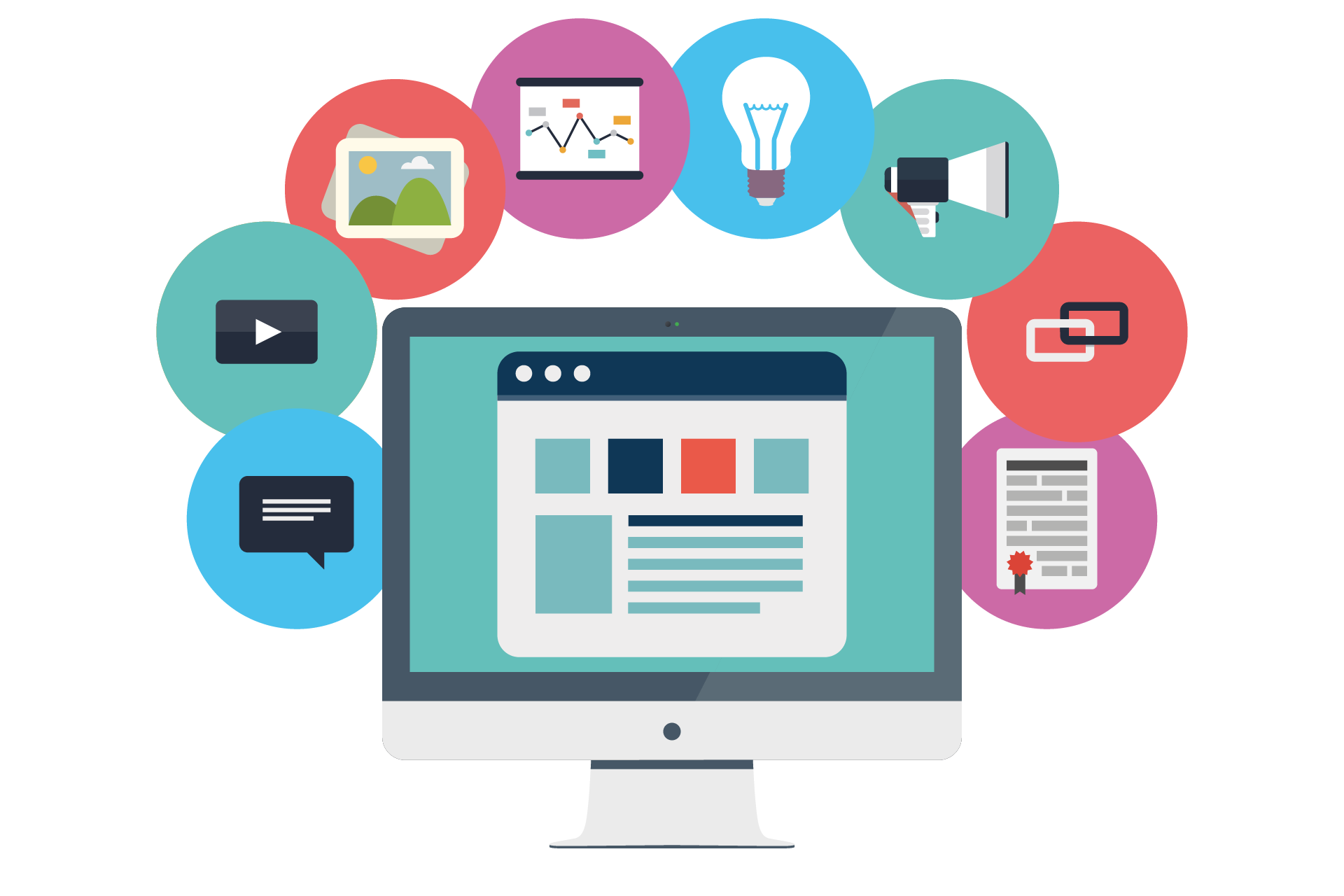
e-Learning “Fundamentals of Project Management”
With individual telecoach. 4 weeks with self-controlled learning times
Project Management Simulation Workshop
1 day in classroom o 2 half day virtual meetings

>>>>>>>>>> approx. 6 weeks with individual coaching >>>>>>>>>>
Why are more than 790.000 executives around the globe certified as PMP?
For many companies, filling high-level responsible posts requires only employees who have special project management qualifications.
Now, while there are certificates from various associations and organizations that are recognized as evidence of professional project management skills. However, the PMI is the world’s largest association.
As a result, PMI’s certificates are the most widespread and have a very high reputation. As a PMP certification, the project manager can therefore open many doors that offer attractive career opportunities.
Reason 2: Prospects of above average income
For a project manager or project manager to be able to pass the exam by which he obtains the certificate as a PMP, he must fulfill strict access requirements.
The PMI divides the participants into two categories:
- Category 1 is assigned to participants who have a Baccalaureate degree. In Germany, that would be a higher education diploma or higher. You must have gained at least three years of project management experience over the past eight years. During this three-year activity, they must have worked for at least 4,500 hours in a senior or senior project management role.
- Category 2 is assigned to test takers who have no degree equivalent to a baccalaureate. In Germany, those are participants with a high school diploma or completed vocational training. You must have at least five years of project management experience from the past eight years. They must have worked at least 7,500 hours as senior or senior project managers as part of their job.
All test participants must also have a project management-specific training of at least 35 hours. The PMP Prep Pack fulfills this requirement.
The participation in the exam is therefore reserved for project managers and project managers who, in addition to their relevant training, also have practical work experience. With the certificate they prove their extensive competencies and develop them at the same time.
For employers, the PMP certificate is therefore a reliable proof that they are dealing with a competent, experienced and experienced specialist. In order to win over these experts and to bind them to the company, they are therefore prepared to agree on an attractive remuneration.
Reason 3: Personal development
The exam does not only ask for existing knowledge and skills. Instead, the project manager acquires new knowledge in preparation for the exam, updates its existing competencies, and deepens them.
Through exchanges with colleagues, he can get new impulses for his work and make interesting contacts for future projects and cooperations. In this respect, the certificate gives him the opportunity to progress both professionally and personally to develop.
Reason 4: Knowledge and ability up to date
Project managers with a PMP certificate are always up to date on skills. This is partly due to the fact that the PMI regularly updates the examination content and adapts it to current developments. On the other hand, the certificate has a validity of three years.
To retain PMP status, project managers must accumulate at least 60 Professional Development Units (PDUs) over a three-year cycle. A PDU corresponds to a one-hour further education.
The advanced training courses can be completed by certified project managers, for example in the form of trainings, the attendance of specialist events and seminars or by self-taught studies.
Reason 5: Competences in the international context
Projects on an international level play an increasingly important role in everyday working life. To ensure smooth processes and successful cross-border cooperation, it is helpful to use a consistent terminology and standardized approaches.
Certification as a PMP ensures that the project manager has extensive methodological knowledge that has become established as a standard and has proven itself in practice. This significantly facilitates international cooperation.
Reason 6: Comprehensive operational capability
In particular, the PMBOK Guide as a standard work in project management focuses on processes. The basic idea behind this is that when implementing a project, many different processes take place, interlock and interact.
Therefore, the collected methodological knowledge is structured using processes and transferred to standards. At the same time, the methods and terminology are described as being applicable to projects in a wide variety of fields, regardless of industry, organization or corporate structure.
This creates the basis for project teams whose members come from different disciplines. For the project manager, this means that he is not dedicated to one department but can also be active in other areas.

Virtual kickoff meeting
1 hour, each one at his/her place
-
Team building
-
Guided tour of the e-learning and collaboration platforms
-
Validation of objectives
-
Validation of the individual and team work methods

e-Learning
“Fundamentals of Project Management”
With individual telecoach. 4 weeks with self-controlled learning times
What is it about?
The e-learning course “PM Fundamentals” is a basic introduction to project management which gives insights in the methods and concepts of project management.
With the help of 36 lessons grouped into 9 thematic modules, the learner is introduced step by step to the essentials of project managements, its reasoning as well as its instruments and methods.
Advantages
- Learning progress on individual basis;
- Comprehensive introduction;
- Exercises to apply knowledge;
- Examples and instruction on how to apply the knowledge;
- Several languages.
Langues
Croatian, Dutch, English, French, German, Polish, Portuguese, Russian, Spanish, Swedish and Vietnamese.
Requirements
- Permanent internet access.
- Latest version of internet browsers and multimedia plug-ins.
Duration
12 hours on the average (equal to 12 PDUs or contact hours).
Target groups
- Newcomers in project management;
- Junior project managers;
- Members of project teams;
- Experience managers who are looking for the theoretical and methodological background.
Prerequisites
No prerequisites required.
Learning objectives
At the end of the course, the participants will be able to:
- understand the principle concepts of project management;
- apply project management methods and instruments into practice;
- manage a small or medium size project;
- contribute to project success.
Content
- Project initiation and organization;
- Scope definition and development of the concept;
- Planning of activities and resources;
- Risk analysis, monitoring and control;
- Estimations, budget and cost control;
- Quality planning and control;
- Performance control and change management;
- Training and team building, communication;
- Project closing, lessons learned.
How does it work
The learner acquires – on an individual basis – the technical, formal and procedural knowledge and fundamental tools of project management, so that they can successfully undertake their first projects.
Emphasis is given to the application of knowledge with the help of exercises and explanations how to apply the theory in practice.
The learners are not alone; they are accompanied by an experience distant coach who responds to questions, motivates, and checks the progress. (optional)


Project Management Simulation Workshop
1 day in classroom o 2 half day virtual meetings
Video < 2 min.
What is it about?
A serious game which puts you instantly in the role of a project manager!
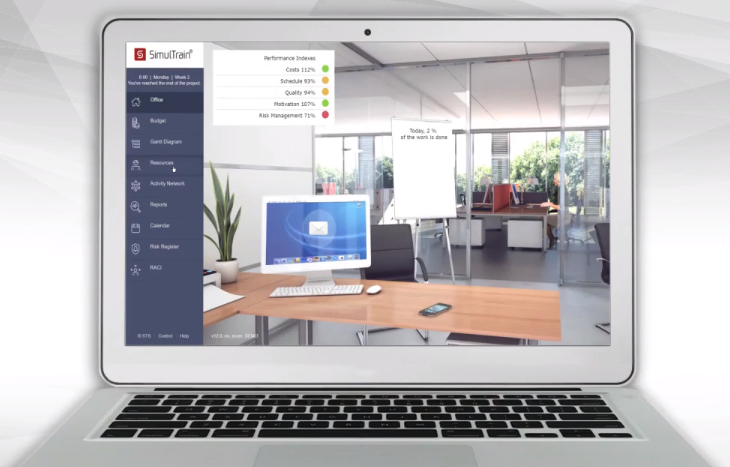
SimulTrain® is an online simulation of project management which allows learners to acquire core project management competencies as well as teamwork and leadership skills in an enjoyable way.
So far, the simulator is used in more than 50 countries and has contributed to the training of more than 150’000 project managers.
They enjoyed to be exposed to a close to real project, to take decisions under pressure and finally to review them – without any implication on their promotion or career.
Advantages
- SimulTrain integrates all aspects of project management;
- Learning by making mistakes;
- Close to reality;
- Knowledge and skill acquisition that will never be forgotten;
- An opportunity for practicing the execution phase of a project;
- Challenging, encouraging, and fascinating;
- A competitively-priced, hands-on experience which shows the reality and consequences of leading a project.
Languages
SimulTrain is available in more than 20 languages.
Depending on the languages, there are up to 7 scenarios at disposal, reflecting simulations of projects in different areas.
Requirements
SimulTrain can be run online or with a desktop version.
Duration
The simulation lasts for about 8 hours including the phases of planning, execution, and debriefing.
In most cases, the simulation is split into two parts over two days and combined with other learning activities such as company-specific case studies. During two times 4 hours, the learners are confronted with the planning and the execution of a project.
Target groups
- Project managers learn to apply their knowledge and review their decisions with the help of an experienced trainer;
- Junior project managers learn how a project is to be planned and executed;
- Senior project manager can review their way of project management.
Prerequisites
Basic knowledge about project management.
Learning objectives
At the end of the simulation, the participants will be able to:
- Plan project resources;
- Use project management tools;
- Control the progress of a project;
- Make team decisions, including in situations of stress;
- React properly in typical situations of project management.
Characteristics
It is a training course for companies and other organizations, private or public. The training takes place in the form of a seminar, usually at the client organization or in an appropriate location.
Content
- Project planning;
- Resource allocation;
- Project execution;
- Decision making;
- Project controlling;
- Reporting;
- Project Closing.
How does it work
The project simulation SimulTrain® is primarily used in combination with classroom activities.
In teams of 3 to 4 people, learners play the role of the project manager. The teams have to plan and execute a typical mid-sized project. They immediately see the consequences of the decisions they make. Furthermore, they can track the evolution of the costs, the schedule, the quality as well as the human factors.
With the help of SimulTrain, project manager can make all the mistakes while planning and executing a project and learn from these mistakes – just to a reasonable price!
Full of multimedia interaction, SimulTrain® provides the teams with phone calls, emails, and voicemails to create a realistic and stressful environment – just as in real life. Therefore, learners experience stress and working under pressure.
SimulTrain is also an ideal tool for team building or decision making.
To perform a test : Demo version
GET IN TOUCH
Learnplace Academy
Langemarckstrasse 112
79100 Freiburg, Germany
+49 761 707 30 19
office@learnplace.org